History & Origins
Bonfire Night celebrates the failed Gunpowder Plot of 1605, when Guy Fawkes and his friends tried to blow up the Houses of Parliament in London!


Did you know?
Search name of person, animal, place, thing, etc.
Share
Bonfire Night celebrates the failed Gunpowder Plot of 1605, when Guy Fawkes and his friends tried to blow up the Houses of Parliament in London!
Guy Fawkes wasn’t actually the leader of the Bonfire Night plot – that was Robert Catesby, but Guy Fawkes became the most famous because he was caught guarding the gunpowder!
The plotters who inspired Bonfire Night hid about 36 barrels of gunpowder in a cellar beneath Parliament, which was enough explosive to destroy much of the building (and worse) if the plan had worked!
In 1606, after the Gunpowder Plot, King James I and Parliament made a law to celebrate his survival every year on November 5th — and people kept the tradition until the law ended in 1859!
People would originally burn effigies (models) of the Pope on Bonfire Night, but this later changed to burning ‘Guys’ named after Guy Fawkes!
The Gunpowder Plot that Bonfire Night commemorates was discovered because one of the plotters sent a letter warning his friend Lord Monteagle not to go to Parliament on November 5th!
Guy Fawkes was born in 1570 in York, England. Later, while fighting for Spanish Catholics, he started calling himself “Guido” — the Italian version of his name!
The cellars of the Houses of Parliament are still searched by the Yeoman of the Guard before the State Opening of Parliament, continuing a Bonfire Night tradition that began in 1605!
The rhyme “Remember, remember the 5th of November…” was written down in the mid-1700s — about 140 years after the Gunpowder Plot of 1605.
Guy Fawkes was arrested just after midnight on November 5th, which is why we celebrate Bonfire Night in the evening on that date!
In many British towns, children and neighbours would collect wood weeks in advance of Bonfire Night (5 November). They’d gather old planks, branches or pallets to build a big bonfire and compete to make the tallest pile.
In some parts of Britain, children make a ‘Guy’ for Bonfire Night using old clothes stuffed with newspaper and carry it around asking for “a penny for the Guy”!
The town of Lewes in East Sussex holds the UK’s largest “Bonfire Night” on 5 November (or the Saturday closest if the 5th is a Sunday).
Many British towns have torchlight processions on Bonfire Night, where people parade through the streets carrying flaming torches!
Some communities hold competitions for the best ‘Guy’ on Bonfire Night, with prizes given to the most creative designs!
In Ottery St Mary, Devon, people carry burning tar barrels through the streets on Bonfire Night, a tradition that’s hundreds of years old!
Parkin, a sticky gingerbread cake made with oatmeal and treacle, is the traditional Bonfire Night cake in Northern England!
Bonfire Night toffee, also called treacle toffee or plot toffee, is so hard that it sometimes needs to be broken with a hammer!
Hot baked potatoes cooked in the bonfire’s embers are called ‘jacket potatoes’ and are a traditional Bonfire Night food!
Hot soup served in mugs is a Bonfire Night tradition that helps keep people warm while watching the fireworks!
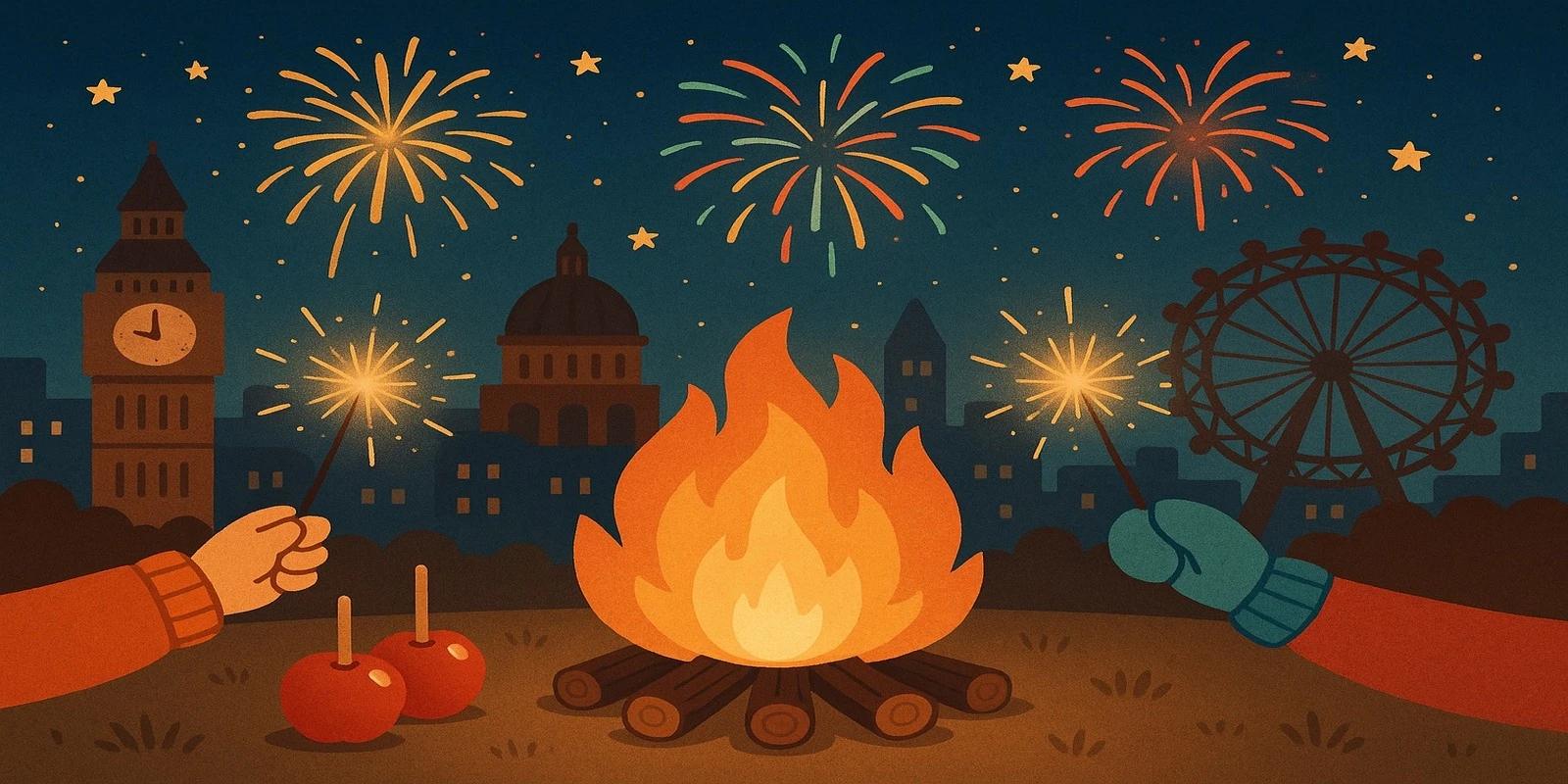
On Bonfire Night, people light big bonfires and fireworks, and fiery colors like orange, red, and gold are used to match the glow of the flames!
Some communities build huge bonfires made of wooden pallets and scrap wood, reaching heights as tall as houses — then they light them together for big street‑celebrations!
Children often wave a sparkler in the air and write their names with it on Bonfire Night — and because the tip of a sparkler can glow at over 1,000 °C (about 1,800 °F), it’s super hot and must always be used with adult supervision!
On Bonfire Night children often learn the old chant: ‘Remember, remember the 5th of November, Gunpowder, treason and plot…’ which remembers the story of the Gunpowder Plot.
Children used to make a dummy called the Guy, wheel him around asking neighbours ‘a penny for the Guy?’, and then burn him on the bonfire on Bonfire Night!
Bonfire Night is celebrated in some former British colonies, including New Zealand and parts of Canada!
The story of Guy Fawkes helped inspire the graphic novel and movie V for Vendetta — and the now‑famous ‘Guy Fawkes mask’ that the hero wears is based on his face.
In early America some people marked 5 November (called Bonfire Night or ‘Pope Night’) by burning effigies and lighting bonfires — but after the American Revolution the celebrations faded away.
Some customs from Guy Fawkes Night (also called Bonfire Night) and the older festival of Halloween blended together in the UK — for example, big bonfires and effigies were used for Bonfire Night, and these fire‑traditions merged with autumn ‘spirit’ celebrations.
The name Guy Fawkes became linked to the straw dolls called ‘guys’ that children made and burned on Bonfire Night — and over time, ‘guy’ came to mean ‘any fellow or person’!
Some parts of Northern Ireland celebrate with bonfires on Bonfire Night but also on different dates for different reasons!
Many British people living abroad do organize their own celebrations of Guy Fawkes Night (also known as Bonfire Night) to maintain the tradition.
Bonfire Night happens on 5 November, which is in the autumn in the UK. Because it’s late in the year, it often gets darker and chillier — making the bright fireworks and glowing bonfires look extra awesome!
The early darkness in November means Bonfire Night firework displays can start as early as 6pm!
Some places hold their Bonfire Night celebrations on the weekend nearest to November 5th to make it easier for families to attend!