Basic Information
Mississippi’s official name is “The State of Mississippi,” which comes from the Ojibwe words “misi-ziibi” meaning “Great River.”


Did you know?
Search name of person, animal, place, thing, etc.
Share
Mississippi’s official name is “The State of Mississippi,” which comes from the Ojibwe words “misi-ziibi” meaning “Great River.”
Jackson is the capital city of Mississippi! It was named after President Andrew Jackson and is home to about 153,000 people.
Mississippi became the 20th state on December 10, 1817, more than 200 years ago!
About 2.9 million people live in Mississippi, which is roughly the same as the population of the country of Armenia.
Mississippi is in the southeastern United States! It borders Tennessee to the north, Alabama to the east, Louisiana and the Gulf of Mexico to the south, and Arkansas to the west.
Mississippi's official nickname is "The Magnolia State" because of all the beautiful magnolia trees that grow there.
Mississippi's state motto is "Virtute et Armis," which is Latin for "By Valor and Arms."
Mississippi’s state flag, adopted in 2021, shows a white magnolia flower surrounded by stars, with the words “In God We Trust” on a blue background with red and gold stripes.
Mississippi is the 32nd largest state, covering about 48,430 square miles—and it’s almost twice as big as the country of Latvia!
Mississippi’s state bird is the mockingbird, a smart bird that can copy the songs of many other birds and sounds it hears!
The magnolia is Mississippi’s state flower, and its big white blooms can grow up to about 12 inches wide—almost as big as a dinner plate!
Mississippi's state tree is the magnolia tree, which can grow up to 90 feet tall—that's as high as a 9-story building!
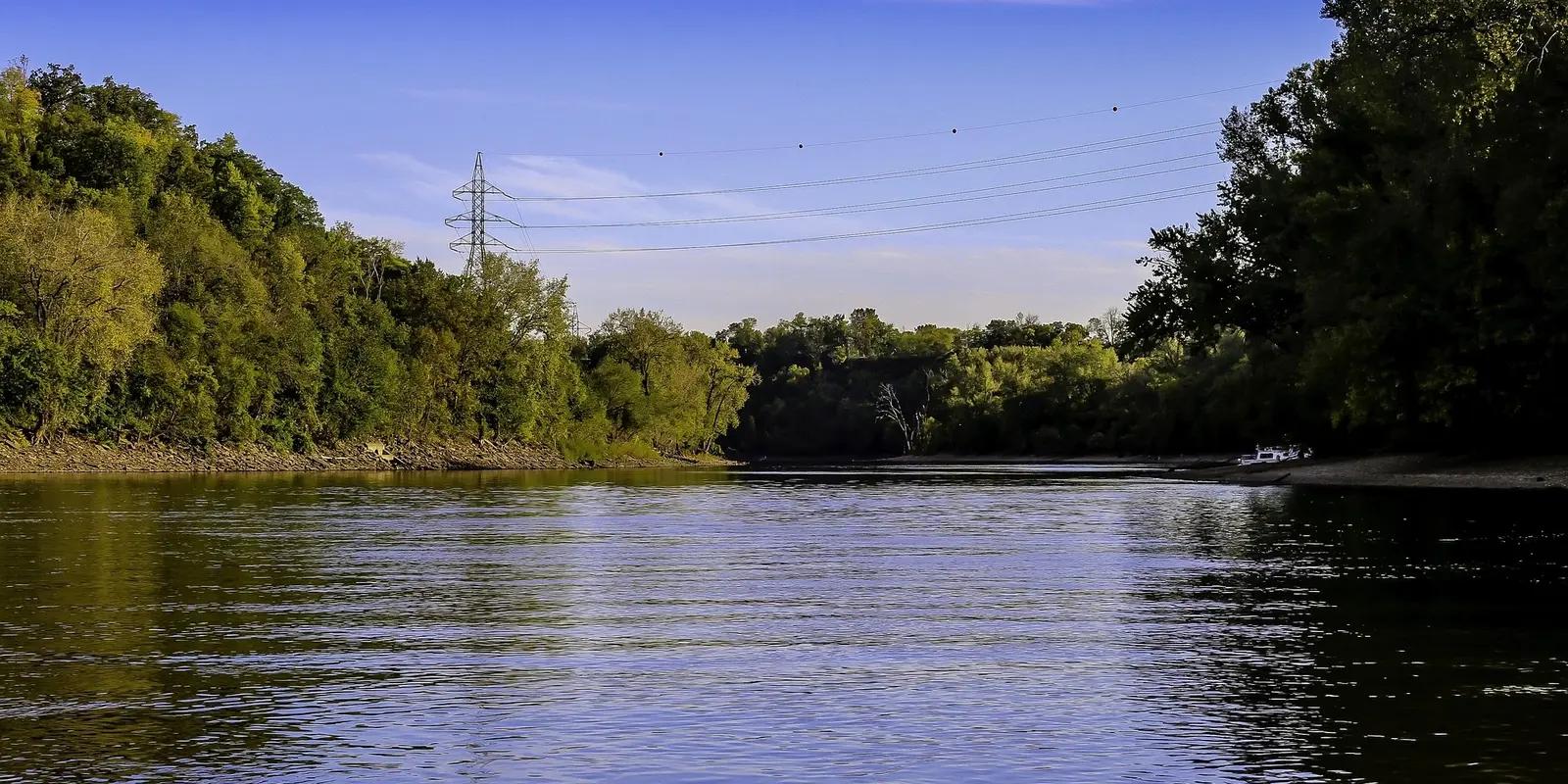
The Mississippi River forms most of the western border of the state, stretching 359 miles along Mississippi's edge.
Mississippi has no big mountains! Instead, it has gentle hills in the northeast and wide, flat plains in the Delta region.
The Mississippi Delta is a flat, fertile region in the northwest of Mississippi, and it looks like a triangle shape on a map!
Mississippi has 82 counties, and Yazoo County is the largest at about 933 square miles—but it’s still smaller than the tiny state of Rhode Island!
The highest point in Mississippi is Woodall Mountain, which is only 807 feet tall—shorter than the Eiffel Tower!
Mississippi has many rivers! Some of the most important ones are the Mississippi, Pearl, Pascagoula, Tombigbee, and Yazoo rivers, along with several others that flow across the state.
Mississippi has over 250,000 acres of lakes and reservoirs, and the largest is Sardis Lake at about 98,500 acres!
Mississippi’s Sardis Lake is one of the largest man-made lakes in the state, covering about 98,500 acres when full!
Mississippi has about 25 state parks spread across the state, giving wildlife a safe home and kids fun places to explore and play!
Mississippi has about 26 miles of white-sand beaches along the Gulf of Mexico, and much of the sand was brought in because the state’s natural coastline is marshy!
Mississippi has a humid subtropical climate, which means hot, humid summers with temperatures often reaching above 90°F and mild winters.
Mississippi gets about 56–60 inches of rain each year, making it one of the rainiest states in the United States!
Mississippi experiences around 30–60 tornadoes each year on average, and most tornadoes happen in the spring months, especially from March to May!
Mississippi is home to over 2,700 native plant species, including hundreds of different trees, shrubs, and other plants that support wildlife across the state!
Alligators live in Mississippi's waterways, with some growing up to 14 feet long—that's the length of a small school bus!
White-tailed deer are so common in Mississippi that there are about 1.75 million of them—that's more than half the number of people in the state!
Mississippi has over 70 species of reptiles, including more than 50 kinds of snakes, with only 6 being venomous.
The longleaf pine forests that once covered much of Mississippi are special ecosystems that need regular fire to stay healthy and support wildlife!
The Mississippi Flyway is a bird migration route that millions of birds use each year to travel from Canada to warmer regions like the Gulf of Mexico, Central America, and even South America!
Some parts of Mississippi have very dark, rich soil—especially in the Black Belt region.
Native American tribes like the Choctaw, Chickasaw, and Natchez lived in Mississippi for thousands of years before Europeans arrived!
Native American mound builders created huge earthen mounds in Mississippi and across the region, starting more than 2,000 years ago and continuing for many centuries!
Emerald Mound, built by Native American mound builders and later used by the Natchez people around 1400 AD, is the second-largest ceremonial mound in the United States!
The first European to explore the Mississippi region was Spanish explorer Hernando de Soto in the early 1540s, almost 500 years ago!
The French established the first European settlement in Mississippi at Fort Maurepas (now Ocean Springs) in 1699.
Mississippi was once part of the French territory of Louisiana before becoming a British territory after the French and Indian War.
The Natchez Trace is a historic path that stretches about 444 miles, and it was used by Native Americans and early American settlers for travel!
During the Civil War, the city of Vicksburg was under siege for 47 days before surrendering to Union forces on July 4, 1863!
The Mississippi River changed course in 1876, leaving Vicksburg without direct river access and forming an oxbow lake beside the city!
Mississippi became the second state to secede from the Union on January 9, 1861, and it was fully readmitted to the Union in 1870 after the Civil War!
The world’s first human lung transplant was performed by Dr. James Hardy at the University of Mississippi Medical Center in 1963, but it was not considered a long-term successful transplant.
The Civil Rights Movement included many important events in Mississippi, like the Freedom Rides of 1961 and Freedom Summer of 1964.
Medgar Evers, an important civil rights leader, worked in Mississippi to end segregation and help African Americans register to vote.
The Mississippi Freedom Democratic Party formed in 1964 to challenge the state's all-white delegation to the Democratic National Convention.
Mississippi was the last state to ratify the 13th Amendment, which abolished slavery, and didn't officially do so until 2013—148 years after it became law!
The Great Mississippi Flood of 1927 was one of the worst natural disasters in American history, flooding 27,000 square miles of land.
Cotton was once so important to Mississippi's economy that it was called "King Cotton," and by 1860, Mississippi produced more cotton than any other state.
Mississippi didn't officially ratify the 19th Amendment, which gave women the right to vote, until 1984—64 years after it became law!